Please note: Due to ongoing global shipping disruptions, some orders may experience extended delivery times. We appreciate your patience and are working to minimise any delays.

Archive for year: 2026

Ultrasonic Jewellery Cleaning: How to Clean Jewellery Like a Professional
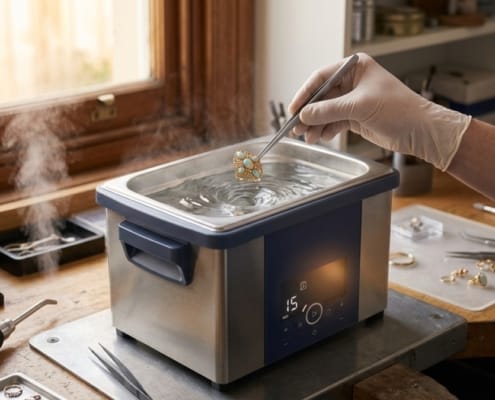
Ultrasonic cleaning is how jewellers, watchmakers and retailers bring the sparkle back to rings, chains and gemstones — reaching behind settings and into detail that a cloth or brush simply can’t. Elma has supplied the trade in Australia for decades, and the process is just as effective in a workshop as it is on a retail counter.

This guide covers how it works, the right solution and machine to use, a step-by-step, and — importantly — what you should never put in the bath.

Why ultrasonic is the jeweller’s choice

An ultrasonic cleaner works by cavitation — microscopic bubbles imploding throughout the solution, lifting grime, skin oils, hand cream and polishing residue from every surface, including under stones and inside settings. (See how ultrasonic cleaning works.) The result is a deep clean in minutes, with no scrubbing and no scratching.

It’s used two ways in the trade:
Retail & service — restoring customers’ rings, chains and watches to showroom condition.
Manufacturing & repair — removing polishing compound, rouge and lapping paste from freshly worked pieces.

The right solution makes the difference

Plain water under-performs. Match the concentrate to the job:

  • Elma Super Clean — a mild, ammoniated concentrate made specifically to clean and brighten gold, silver and hard-stone jewellery. Use at 3–10% in water; a 1-litre bottle goes a long way. The go-to for retail and general jewellery cleaning.
  • Tec Clean A2 — alkaline, ideal for removing grinding and polishing compounds, lapping media and grease from precious and non-ferrous metals. The choice for manufacturing and the polishing bench.

Our ultrasonic cleaning solutions guide covers the full range and dilutions.

Choosing a machine

For jewellery, a smaller heated bench unit is usually ideal — and a higher ultrasonic frequency cleans delicate pieces more gently:

  • Elmasonic EASY series — well-built, heated entry-level units; a sensible choice for a retail counter or small workshop.
  • P series (multi-frequency) — offers an 80 kHz mode that’s quieter and gentler for fine, delicate jewellery, plus 37 kHz for heavier cleaning.
  • A Sweep mode helps clean evenly, and heating speeds up the result.

Browse the full ultrasonic cleaner range or use our guide to choosing a cleaner to match capacity to your volume.

How to clean jewellery — step by step

  1. Fill the tank with warm water and the correct dose of Super Clean (typically 3–10%).
  2. Degas a fresh solution for a couple of minutes so cavitation is at full strength.
  3. Load pieces into the insert basket — never directly on the tank floor, and don’t overcrowd.
  4. Run a short cycle (often 3–10 minutes depending on soiling).
  5. Rinse in clean water and dry with a soft, lint-free cloth — or finish with a steam cleaner for a flawless result.
  6. Inspect settings before and after, especially on older or repaired pieces.

For a professional finish, many jewellers pair ultrasonic cleaning with an Elma steam cleaner to blast away loosened residue and water spots.

What NOT to put in the bath

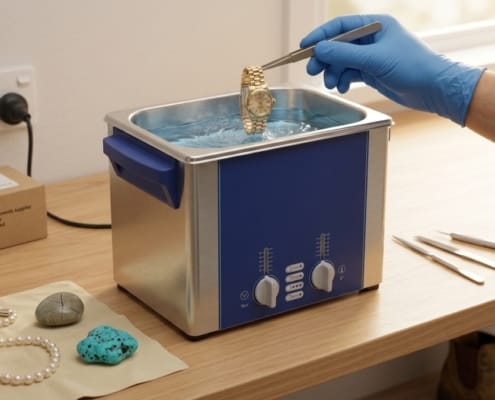
This matters: some stones and settings are damaged by ultrasonics. Keep opals, pearls, coral, emeralds, turquoise and other soft or treated stones out, along with glued settings, fragile antiques and thinly plated pieces. Our full guide on what not to put in an ultrasonic cleaner has the complete list — read it before cleaning customer pieces.

For jewellery businesses

If you run a retail store, repair workshop or manufacturing bench, the right ultrasonic-and-steam setup pays for itself quickly in time saved and finish quality. Elma equipment is German-made and built for daily professional use. Contact our Australian team and we’ll match a cleaner and solution to your work — or browse Super Clean and the ultrasonic cleaner range to get started.

What Not to Put in an Ultrasonic Cleaner
Ultrasonic cleaning is remarkably gentle and remarkably powerful — and that combination means a few items shouldn’t go in the bath. The same cavitation that lifts grime from a watch bracelet can loosen a glued setting or worsen a hairline crack. Knowing what to keep out protects your valuables and your equipment.

Here’s a clear, practical list of what not to put in an ultrasonic cleaner, and why.

Soft, porous or heat-sensitive gemstones

The cavitation and warmth that suit hard stones can damage softer or porous ones. Keep these out of the ultrasonic bath:

  • Opals, pearls and coral — porous and easily cracked, crazed or dulled.
  • Emeralds — commonly oil- or resin-treated; ultrasonic cleaning strips the treatment and can worsen their natural inclusions.
  • Turquoise, lapis lazuli, malachite, onyx and other porous/dyed stones — can absorb liquid, lose colour or crack.
  • Tanzanite, topaz, amber, jet and moonstone — sensitive to vibration and temperature shock.

Hard, untreated stones such as diamonds, sapphires and rubies are generally fine — but if a piece is antique, fracture-filled or you’re unsure, clean it by hand.

Jewellery with vulnerable settings or finishes

  • Glued or pressure-set stones — vibration can loosen adhesives and shake stones free.
  • Plated jewellery (gold or rhodium plate) — repeated ultrasonic cleaning can wear thin plating.
  • Antique, fragile or already-cracked pieces — existing weaknesses can propagate.
  • Costume jewellery — mixed materials and glued components don’t tolerate it well.

Certain metals and finishes

  • Aluminium and soft metals — strong alkaline solutions can etch or discolour them; if you must, use a material-safe neutral solution and test first.
  • Painted, lacquered or coated parts — ultrasonics can lift the coating.
  • Soft or reactive metals like raw brass can spot or tarnish in the wrong chemistry — match the right cleaning solution to the metal.

Watches and electronics (with caveats)

  • Non-sealed watch movements and dials — water ingress can ruin them. Only fully sealed cases by a watchmaker who knows the rating.
  • Items with batteries or live electronics — remove power sources first; uncoated boards may need a specialist flux-removal process rather than a general bath.

Don’t use the wrong liquid, either

  • Flammable solvents (petrol, acetone, pure alcohol) must never be used in an ultrasonic tank — a serious fire and fume risk. Use purpose-made water-based concentrates.
  • Household detergents foam, and foam kills cavitation — see our guide to ultrasonic cleaning solutions.
  • Bleach corrodes stainless tanks and should be avoided.

A few good habits

  • Use an insert basket so items never sit directly on the tank floor (direct contact can damage both the item and the transducer).
  • Don’t overcrowd — parts need solution around them to clean.
  • When in doubt, test on an inconspicuous area or clean by hand.

Still unsure?

If you’re not certain whether an item is ultrasonic-safe, it’s always better to ask first. Browse our ultrasonic cleaner range and cleaning solutions, see our guide to choosing a cleaner, or contact our Australian team for advice on your specific items.

Industrial Ultrasonic Cleaners & Parts Washers in Australia
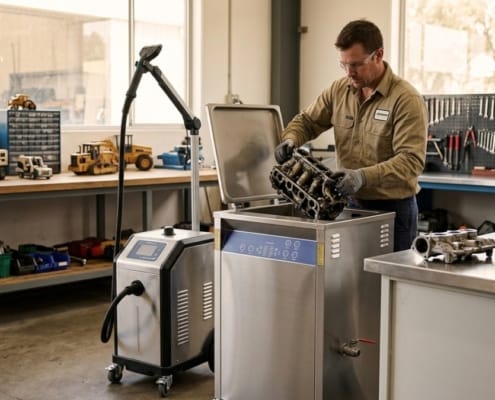
When you’re cleaning production batches, engine and machined components, moulds, filters or maintenance parts, a benchtop unit won’t keep up. Industrial ultrasonic cleaners remove oil, swarf, carbon, lapping paste and production residues from large or high-volume loads automatically — no manual scrubbing, no solvent baths, and a consistent result every cycle.

This guide covers how industrial ultrasonic cleaning works, what to look for, and the Elmasonic ranges available in Australia — from heavy-duty benchtop units up to 255-litre floor-standing systems, all made in Germany by Elma and supplied by Elma Ultrasonics Australia.

Why ultrasonic for industrial parts cleaning?

An ultrasonic parts washer cleans by cavitation — microscopic bubbles imploding across every submerged surface, reaching into blind holes, threads, lumens and fine detail that spray washers and manual cleaning miss. For a production environment that means:

  • Throughput — clean a full basket of parts at once, repeatably, while staff do other work.
  • Reach — internal passages and complex geometries get cleaned, not just exposed faces.
  • Gentler than abrasive methods — no media blasting or wire-brushing damage.
  • Lower solvent use — water-based concentrates replace hazardous solvent degreasing.

What to look for in an industrial unit

  • Tank capacity matched to your largest part and batch size — choose a tank at least 20% larger than your biggest item.
  • Selectable frequency. Lower frequencies (around 25 kHz) hit hardest for stubborn contaminants like lapping/polishing paste and carbon; higher frequencies (37–45 kHz) suit drilling emulsions, oils and more delicate surfaces.
  • Sweep, Pulse and Dynamic modes — Sweep evens out the sound field for uniform cleaning, Pulse boosts peak power for tenacious soils, and Dynamic alternates the two (Elma’s X-tra ST lifts output up to ~20%).
  • Heating — warm solution cleans faster; industrial baths run hot for oils and grease.
  • Robust stainless construction, drainage and continuous-duty rating for a production line.
  • Three-phase power for the largest floor-standing tanks.

The Elmasonic industrial range (Australia)

Elmasonic X-tra ST — floor-standing industrial systems

The Elmasonic X-tra ST range is built for rugged, continuous production cleaning, with tanks from 83 to 255 litres for engineering, manufacturing, aerospace, rail and maintenance workshops. Units offer switchable 25/45 kHz operation, Sweep, Pulse and Dynamic modes, heating and built-in drainage:

Elmasonic X-tra (benchtop, heavy-duty)

The Elmasonic Xtra series brings production-grade cleaning to the bench, with tanks from 3 to 30 litres, integrated Sweep, switchable Dynamic mode, continuous-duty stainless tanks and a stainless cover included. Ideal for workshops, jewellery studios and automotive servicing that need industrial performance in a smaller footprint.

Elmasonic P series (professional / multi-frequency)

The Elmasonic P series offers dual 37/80 kHz frequencies, heated tanks (2.75–28 L) and Sweep/Pulse/Degas modes — the right choice where you need both industrial cleaning power and a gentle option for delicate or precision components.

Match the right cleaning solution

The machine is only half the job — pair it with the correct concentrate. For industrial soils, an alkaline TEC CLEAN grade (A3/A4) handles oils, grease, soot and cooling lubricants, while acidic S1 tackles rust and scale. Our ultrasonic cleaning solutions guide walks through choosing by material and contaminant, and the full cleaning chemicals range is available in 1 L up to bulk sizes.

Specifying a system

For a production line or a custom configuration — multi-tank wash/rinse/dry lines, filtration, larger capacities or automation — sizing depends on your part geometry, contamination and throughput. Our guide to choosing an ultrasonic cleaner covers the fundamentals, and our Australian team can spec a system to your application. Browse the full ultrasonic cleaner range to get started.

Dental Ultrasonic Cleaners in Australia: A Practice & Lab Buyer’s Guide
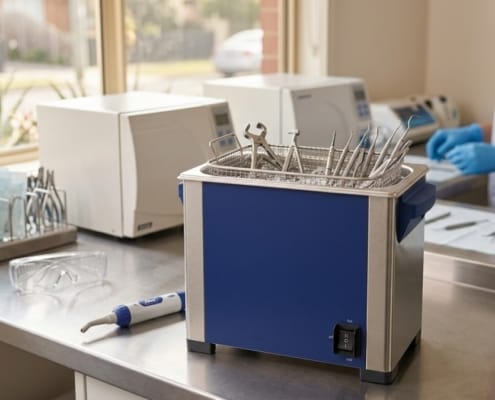
Every dental practice and laboratory in Australia needs a reliable way to clean instruments before they’re sterilised. Ultrasonic cleaning is the established method for that first, critical step — reaching into hinges, serrations, drill flutes and other detail that manual scrubbing can’t, while reducing the handling of contaminated sharps.

This guide explains where an ultrasonic cleaner fits in dental instrument reprocessing, what to look for when buying one, and which Elma models suit a practice or lab. It’s grounded in the Elma ultrasonic cleaner range stocked in Australia.

Cleaning is not sterilisation — and that distinction matters

The most important thing to be clear on: an ultrasonic cleaner cleans instruments; it does not sterilise them. As Elma’s hygiene specialists put it, “what isn’t clean can never be sterile.” Ultrasonic cleaning is the cleaning stage that comes before sterilisation, not a replacement for your autoclave.

In Australia, instrument reprocessing in office-based practices is guided by AS/NZS 4815 (and AS/NZS 4187 for healthcare facilities). Ultrasonic cleaning supports the cleaning portion of that process. Always follow the relevant standard, your practice’s infection-control protocol, and each instrument manufacturer’s instructions for use — this article is buyer guidance, not a compliance specification.

The reason cleaning matters so much: any blood, tissue or saliva left on an instrument can shield microorganisms from the steriliser, and can carry the risk of cross-contamination between patients. Removing that bioburden thoroughly is what makes subsequent sterilisation effective.

Why ultrasonic beats manual scrubbing

Ultrasonic cleaners work by cavitation — microscopic bubbles forming and imploding throughout the bath, scrubbing every submerged surface. (See how does ultrasonic cleaning work? for the detail.) For dental instruments that means:

  • Reaches what brushes can’t — box joints, ratchets, knurled handles, the flutes of high- and low-speed handpieces and burs.
  • Gentler and more consistent than hand scrubbing, with less risk of damaging fine tips.
  • Safer for staff — far less manual handling of contaminated sharps.
  • Repeatable — the same result every cycle, rather than depending on who’s at the sink.

What to look for in a dental ultrasonic cleaner

Not every benchtop cleaner is suited to instruments. The features that matter in a dental setting:

  • Degas — removes dissolved air from fresh solution so cavitation is at full strength (important when you change solution daily).
  • Sweep — distributes the ultrasonic field evenly so there are no dead spots and no standing-wave hotspots.
  • Heating with a protein-safe limit — warm solution cleans better, but instruments carrying blood must not be heated too far, too fast. Elma’s purpose-built dental units automatically switch heating off at around 41 °C to prevent blood-protein residues coagulating onto instruments.
  • A lid — contains aerosols and reduces noise during the cycle.
  • Basket or insert — keeps instruments off the tank floor for even cavitation and easy, no-touch loading/unloading.
  • Stainless tank + drain — easy to wipe down and empty hygienically.
  • The right tank size for your instrument throughput.

Which Elma model is right?

Elma (made in Germany, established 1948) offers a range that scales from a single surgery to a busy lab or sterilising department. All are available through Elma Ultrasonics Australia:

  • Elmasonic EASY series — straightforward, well-built entry-level units with heating; a sensible choice for a smaller practice. View the EASY series.
  • Elmasonic P series — professional-grade units with Degas, Sweep and adjustable power, ideal where instrument cleaning quality is paramount. View the P series.
  • Elmasonic Select / Medical units — used in central instrument preparation and larger workloads, including a 14-litre medical model for higher capacity.
  • Elmasonic DENTA-PRO — designed specifically for the dental practice, with pre-set cleaning programmes (time, temperature, sweep, degas already configured) and the automatic 41 °C heating cut-off, so the operator just selects a programme and presses start.

Not sure which capacity suits your throughput? Our guide to choosing an ultrasonic cleaner walks through tank size, frequency and power, or contact our Australian team for a recommendation.

The right cleaning solution

Plain water under-performs and isn’t appropriate for instrument cleaning. Use a purpose-made concentrate at the correct dilution — for mixed instruments a material-safe neutral solution is a common starting point, and Elma supplies an enzymatic/instrument range alongside the general TEC CLEAN concentrates. Our ultrasonic cleaning solutions guide explains how to match chemistry to the job; for instrument reprocessing, follow your protocol and the solution’s data sheet for dilution, contact time and temperature.

A correct dental cleaning workflow

A typical sequence (always defer to AS/NZS 4815 and your own protocol):

  1. Pre-clean — remove gross debris and keep instruments moist until processing.
  2. Ultrasonic clean — load the basket without overcrowding, use the correct solution dilution and temperature, run a full cycle (degas fresh solution first).
  3. Rinse thoroughly to remove loosened soil and detergent.
  4. Dry and inspect — check each instrument is visibly clean before it goes further.
  5. Sterilise in your autoclave per the relevant standard.

Overcrowding the basket, skipping degas, or running exhausted solution are the most common reasons for poor results — change the solution regularly and don’t stack instruments on top of each other.

Ready to choose?

Browse the full Elma ultrasonic cleaner range and cleaning chemicals, read our deeper dives on ultrasonic cleaning for dental laboratories and for healthcare, or contact our Australian team and we’ll help you match a cleaner and solution to your practice.

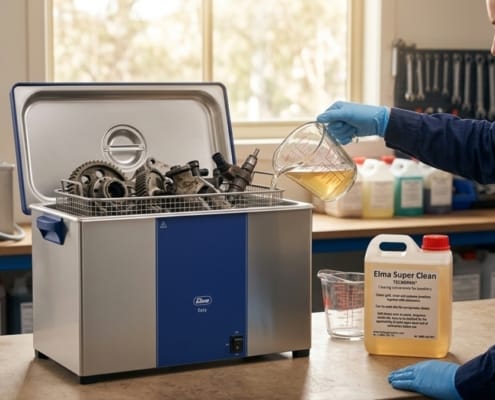
Ultrasonic Cleaning Solutions & Chemicals: How to Choose the Right One

The single biggest factor in how well your ultrasonic cleaner performs isn’t the machine — it’s the cleaning solution you put in it. Run plain tap water and you’ll get mediocre results. Add the right concentrate at the right dilution and the same cleaner will strip oil, grease, polishing paste, carbon, rust and oxidation in minutes.

This guide explains how ultrasonic cleaning solutions work, the three chemistry types, and exactly which Elma concentrate to choose for your material and the contamination you’re removing. Everything below is drawn from the Elma TEC CLEAN range stocked here in Australia.

Why the solution matters more than you think

Ultrasonic cleaners work by cavitation — millions of microscopic bubbles forming and collapsing against the surface of your parts, scrubbing every crevice the eye can’t reach. (If you want the physics, see What is cavitation in ultrasonic cleaning? and How does ultrasonic cleaning work?)

A purpose-made cleaning concentrate does three things plain water can’t:

  • Lowers surface tension so cavitation bubbles form more readily and reach into fine detail.
  • Chemically lifts and holds contamination — emulsifying oils and grease, or dissolving rust and limescale — so it doesn’t redeposit on the part.
  • Protects the substrate with corrosion inhibitors and a pH matched to your material.

Using the wrong chemistry — or worse, household detergent — at best cleans poorly and at worst etches, stains or corrodes the very parts you’re trying to clean. That’s why Elma supplies a matched range rather than a single “do-everything” liquid.

The three types of ultrasonic cleaning solution

Every Elma concentrate falls into one of three chemistry families, defined by pH:

TypepHWhat it doesTypical use
Alkaline (A-series)~10.8 – 13.4Emulsifies and lifts oils, grease, soot, lubricants and polishing mediaUniversal and heavy-duty workshop cleaning
Neutral (N-series)~9.3Gentle, material-safe cleaning that won’t attack sensitive surfacesMixed metals, plastics, optics, delicate parts
Acidic (S-series)~1.6Dissolves rust, limescale, oxide films and mineral depositsDe-rusting and descaling metal

Get the family right first, then narrow down to the specific grade.

The Elma TEC CLEAN range at a glance

All Elma concentrates are supplied in 1-litre bottles and diluted with water (typically 3–10%, some down to 1:60 for light work), so a single bottle goes a very long way. Indicative pricing runs from around A$24 to A$42 per litre of concentrate — check each product page for current Australian pricing.

SolutionChemistrypHBest forRemoves
TEC CLEAN A1Alkaline, silicate & phosphate-free10.8Electronics, PCBs, optics, glasses, plasticsLight oils, grease, flux, atmospheric dust
TEC CLEAN A2Alkaline, contains ammonia11.0Non-ferrous & precious metals, brass, nickel, titanium, jewelleryGrinding & polishing paste, lapping media, grease, oil
TEC CLEAN A3Alkaline, emulsifying13.0Stainless, steel, iron, titanium, precious metalsPunching oils, drawing grease, soot, cooling lubricants
TEC CLEAN A4Alkaline, de-emulsifying13.4The all-rounder — steel, aluminium, light metals, brass, plastics, ceramics, glassOil, grease, soot, coking, fingerprints
TEC CLEAN A5Alkaline powder11.5Stainless, steel, iron, aluminium, light metalsResinified oil & grease, polishing media, lacquer, paint, wax
TEC CLEAN N1Neutral, material-safe9.3All metals, plastics, ceramics, glass, rubberOil, grease, grinding paste, lapping & polishing media, sweat, fingerprints
TEC CLEAN S1Acidic, mild1.6De-rusting & descaling stainless, steel, aluminium, brassRust, limescale, oxide films, grease, oil
SUPER CLEANMild alkaline w/ ammoniaJewellery — gold, silver, hard-stone piecesGeneral soiling; brightens precious metals
ALLKLEENAqueous concentrateAutomotive, carburettors, diesel & general engineeringOil, grease, carbon, soot, waxes, mineral & vegetable oils

Note on aluminium: A4 is aluminium-safe, but several strong alkalis (A3) and Allkleen are not suitable for aluminium or light metals. With acidic S1, remove and rinse steel immediately after de-rusting to prevent flash corrosion. When in doubt, test on a scrap part first.

How to choose by material

  • Stainless steel & steel — A3 or A4 for oils and grease; S1 if you’re removing rust or scale.
  • Aluminium & light metals — A4 (specifically formulated to be aluminium-safe) or neutral N1.
  • Brass & non-ferrous metals — A2 or N1; both clean without aggressive attack.
  • Precious metals & jewellery — A2 or SUPER CLEAN for gold, silver and hard-stone pieces.
  • Electronics, PCBs & optics — A1 (silicate and phosphate-free, gentle on fine assemblies).
  • Plastics, ceramics, glass & rubber — neutral N1 is the safe universal choice.
  • Mixed loads / general workshop — A4 is the closest thing to an all-rounder.

How to choose by contamination

  • Oil, grease & cutting fluids ? alkaline A-series (A3/A4 for heavy industrial soiling, A1 for light).
  • Polishing paste, grinding & lapping media ? A2 (jewellers) or N1.
  • Rust, limescale & oxidation ? acidic S1.
  • Carbon, soot & carburettor grime ? ALLKLEEN or A3.
  • Flux residue on electronics ? A1.

Dilution, temperature and getting the most from a bottle

Because these are concentrates, correct dilution matters. As a rule of thumb the TEC CLEAN grades run at 3–10% in water, while heavy-duty aqueous concentrates like Allkleen go much further — 1:60 for light cleaning down to 1:5 for extra-heavy work. Most jobs also clean faster warm: many solutions are designed to run around 60–70 °C, which is why most Elma cleaners include adjustable heating.

A practical consequence: a single 1-litre bottle of concentrate makes many baths of working solution, so the cost-per-clean is low even though the concentrate isn’t free. Always add concentrate to water (not the other way around), degas a fresh bath for a few minutes, and replace the solution once it’s visibly loaded with contamination.

A word on household substitutes

It’s tempting to reach for dish soap or a degreaser from the shelf. Don’t. Household detergents foam — and foam kills cavitation, the entire mechanism your cleaner relies on. They also lack corrosion inhibitors, so they can leave parts spotted or tarnished. Purpose-made ultrasonic concentrates are low-foaming and substrate-matched for exactly this reason.

Which one should you buy?

If you want a simple starting point:

  • General workshop / mixed parts: TEC CLEAN A4
  • Sensitive parts, plastics & optics: TEC CLEAN N1 or A1
  • Jewellery: SUPER CLEAN or TEC CLEAN A2
  • Rust & scale removal: TEC CLEAN S1
  • Automotive & carburettors: ALLKLEEN

Browse the full ultrasonic cleaning chemicals range for current pricing and data sheets, pair it with the right machine using our guide to choosing an ultrasonic cleaner, or contact our Australian team and we’ll match a solution to your application.

Global Shipping Disruptions

Due to ongoing global shipping / transport disruptions, some orders may experience extended delivery times. Read more

Ultrasonic Cleaners for Healthcare

Hospital hygiene In hospitals, the preparation of instruments is a highly complex process, and at the end of it a product is expected to be delivered which presents no risks for patients.

Shopping cart0
There are no products in the cart!
Continue shopping