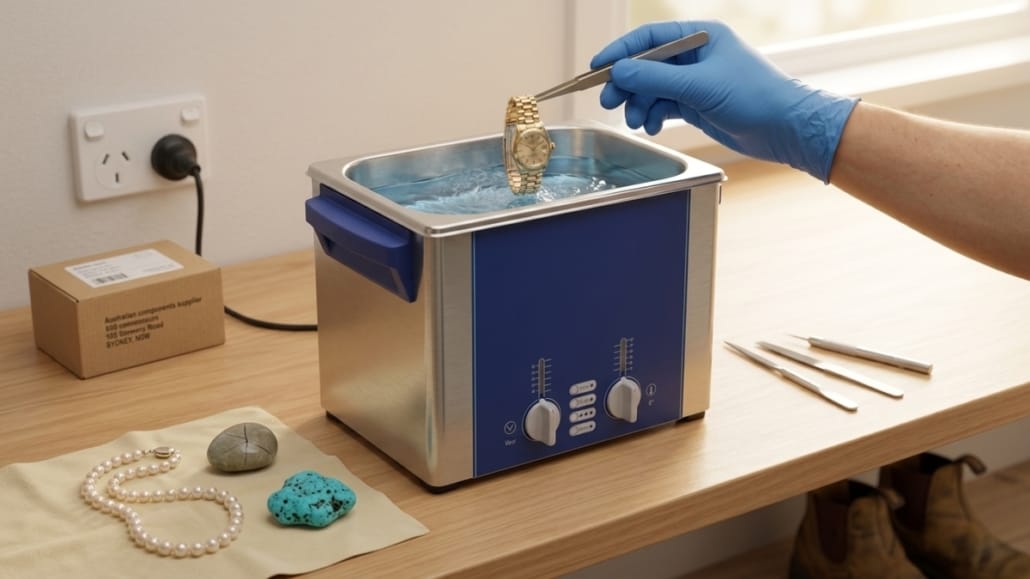
What Not to Put in an Ultrasonic Cleaner
Ultrasonic cleaning is remarkably gentle and remarkably powerful — and that combination means a few items shouldn’t go in the bath. The same cavitation that lifts grime from a watch bracelet can loosen a glued setting or worsen a hairline crack. Knowing what to keep out protects your valuables and your equipment.
Here’s a clear, practical list of what not to put in an ultrasonic cleaner, and why.
Soft, porous or heat-sensitive gemstones
The cavitation and warmth that suit hard stones can damage softer or porous ones. Keep these out of the ultrasonic bath:
- Opals, pearls and coral — porous and easily cracked, crazed or dulled.
- Emeralds — commonly oil- or resin-treated; ultrasonic cleaning strips the treatment and can worsen their natural inclusions.
- Turquoise, lapis lazuli, malachite, onyx and other porous/dyed stones — can absorb liquid, lose colour or crack.
- Tanzanite, topaz, amber, jet and moonstone — sensitive to vibration and temperature shock.
Hard, untreated stones such as diamonds, sapphires and rubies are generally fine — but if a piece is antique, fracture-filled or you’re unsure, clean it by hand.
Jewellery with vulnerable settings or finishes
- Glued or pressure-set stones — vibration can loosen adhesives and shake stones free.
- Plated jewellery (gold or rhodium plate) — repeated ultrasonic cleaning can wear thin plating.
- Antique, fragile or already-cracked pieces — existing weaknesses can propagate.
- Costume jewellery — mixed materials and glued components don’t tolerate it well.
Certain metals and finishes
- Aluminium and soft metals — strong alkaline solutions can etch or discolour them; if you must, use a material-safe neutral solution and test first.
- Painted, lacquered or coated parts — ultrasonics can lift the coating.
- Soft or reactive metals like raw brass can spot or tarnish in the wrong chemistry — match the right cleaning solution to the metal.
Watches and electronics (with caveats)
- Non-sealed watch movements and dials — water ingress can ruin them. Only fully sealed cases by a watchmaker who knows the rating.
- Items with batteries or live electronics — remove power sources first; uncoated boards may need a specialist flux-removal process rather than a general bath.
Don’t use the wrong liquid, either
- Flammable solvents (petrol, acetone, pure alcohol) must never be used in an ultrasonic tank — a serious fire and fume risk. Use purpose-made water-based concentrates.
- Household detergents foam, and foam kills cavitation — see our guide to ultrasonic cleaning solutions.
- Bleach corrodes stainless tanks and should be avoided.
A few good habits
- Use an insert basket so items never sit directly on the tank floor (direct contact can damage both the item and the transducer).
- Don’t overcrowd — parts need solution around them to clean.
- When in doubt, test on an inconspicuous area or clean by hand.
Still unsure?
If you’re not certain whether an item is ultrasonic-safe, it’s always better to ask first. Browse our ultrasonic cleaner range and cleaning solutions, see our guide to choosing a cleaner, or contact our Australian team for advice on your specific items.



