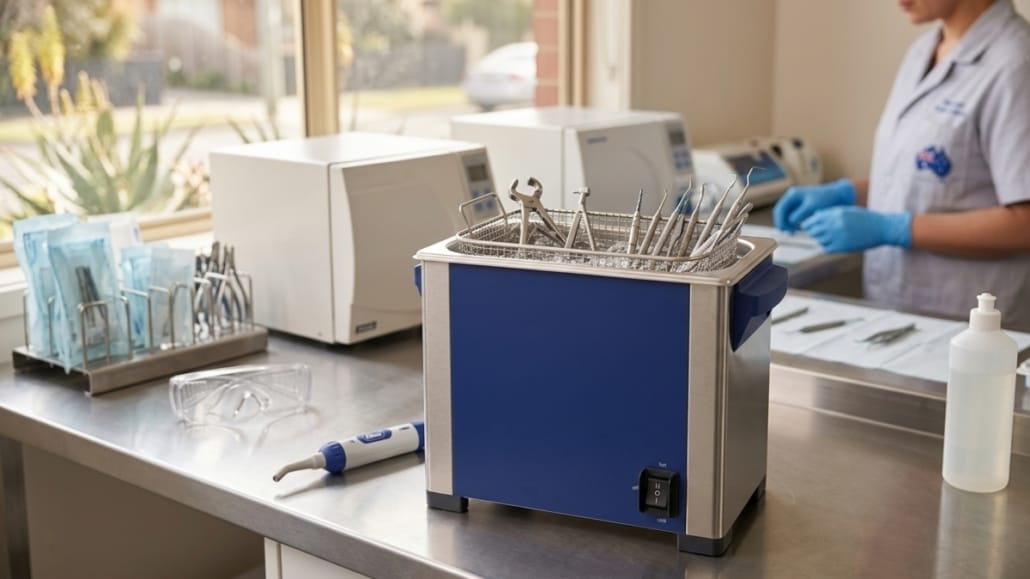
Dental Ultrasonic Cleaners in Australia: A Practice & Lab Buyer’s Guide
Every dental practice and laboratory in Australia needs a reliable way to clean instruments before they’re sterilised. Ultrasonic cleaning is the established method for that first, critical step — reaching into hinges, serrations, drill flutes and other detail that manual scrubbing can’t, while reducing the handling of contaminated sharps.
This guide explains where an ultrasonic cleaner fits in dental instrument reprocessing, what to look for when buying one, and which Elma models suit a practice or lab. It’s grounded in the Elma ultrasonic cleaner range stocked in Australia.
Cleaning is not sterilisation — and that distinction matters
The most important thing to be clear on: an ultrasonic cleaner cleans instruments; it does not sterilise them. As Elma’s hygiene specialists put it, “what isn’t clean can never be sterile.” Ultrasonic cleaning is the cleaning stage that comes before sterilisation, not a replacement for your autoclave.
In Australia, instrument reprocessing in office-based practices is guided by AS/NZS 4815 (and AS/NZS 4187 for healthcare facilities). Ultrasonic cleaning supports the cleaning portion of that process. Always follow the relevant standard, your practice’s infection-control protocol, and each instrument manufacturer’s instructions for use — this article is buyer guidance, not a compliance specification.
The reason cleaning matters so much: any blood, tissue or saliva left on an instrument can shield microorganisms from the steriliser, and can carry the risk of cross-contamination between patients. Removing that bioburden thoroughly is what makes subsequent sterilisation effective.
Why ultrasonic beats manual scrubbing
Ultrasonic cleaners work by cavitation — microscopic bubbles forming and imploding throughout the bath, scrubbing every submerged surface. (See how does ultrasonic cleaning work? for the detail.) For dental instruments that means:
- Reaches what brushes can’t — box joints, ratchets, knurled handles, the flutes of high- and low-speed handpieces and burs.
- Gentler and more consistent than hand scrubbing, with less risk of damaging fine tips.
- Safer for staff — far less manual handling of contaminated sharps.
- Repeatable — the same result every cycle, rather than depending on who’s at the sink.
What to look for in a dental ultrasonic cleaner
Not every benchtop cleaner is suited to instruments. The features that matter in a dental setting:
- Degas — removes dissolved air from fresh solution so cavitation is at full strength (important when you change solution daily).
- Sweep — distributes the ultrasonic field evenly so there are no dead spots and no standing-wave hotspots.
- Heating with a protein-safe limit — warm solution cleans better, but instruments carrying blood must not be heated too far, too fast. Elma’s purpose-built dental units automatically switch heating off at around 41 °C to prevent blood-protein residues coagulating onto instruments.
- A lid — contains aerosols and reduces noise during the cycle.
- Basket or insert — keeps instruments off the tank floor for even cavitation and easy, no-touch loading/unloading.
- Stainless tank + drain — easy to wipe down and empty hygienically.
- The right tank size for your instrument throughput.
Which Elma model is right?
Elma (made in Germany, established 1948) offers a range that scales from a single surgery to a busy lab or sterilising department. All are available through Elma Ultrasonics Australia:
- Elmasonic EASY series — straightforward, well-built entry-level units with heating; a sensible choice for a smaller practice. View the EASY series.
- Elmasonic P series — professional-grade units with Degas, Sweep and adjustable power, ideal where instrument cleaning quality is paramount. View the P series.
- Elmasonic Select / Medical units — used in central instrument preparation and larger workloads, including a 14-litre medical model for higher capacity.
- Elmasonic DENTA-PRO — designed specifically for the dental practice, with pre-set cleaning programmes (time, temperature, sweep, degas already configured) and the automatic 41 °C heating cut-off, so the operator just selects a programme and presses start.
Not sure which capacity suits your throughput? Our guide to choosing an ultrasonic cleaner walks through tank size, frequency and power, or contact our Australian team for a recommendation.
The right cleaning solution
Plain water under-performs and isn’t appropriate for instrument cleaning. Use a purpose-made concentrate at the correct dilution — for mixed instruments a material-safe neutral solution is a common starting point, and Elma supplies an enzymatic/instrument range alongside the general TEC CLEAN concentrates. Our ultrasonic cleaning solutions guide explains how to match chemistry to the job; for instrument reprocessing, follow your protocol and the solution’s data sheet for dilution, contact time and temperature.
A correct dental cleaning workflow
A typical sequence (always defer to AS/NZS 4815 and your own protocol):
- Pre-clean — remove gross debris and keep instruments moist until processing.
- Ultrasonic clean — load the basket without overcrowding, use the correct solution dilution and temperature, run a full cycle (degas fresh solution first).
- Rinse thoroughly to remove loosened soil and detergent.
- Dry and inspect — check each instrument is visibly clean before it goes further.
- Sterilise in your autoclave per the relevant standard.
Overcrowding the basket, skipping degas, or running exhausted solution are the most common reasons for poor results — change the solution regularly and don’t stack instruments on top of each other.
Ready to choose?
Browse the full Elma ultrasonic cleaner range and cleaning chemicals, read our deeper dives on ultrasonic cleaning for dental laboratories and for healthcare, or contact our Australian team and we’ll help you match a cleaner and solution to your practice.



